This unit discusses different types of computers and what they are used for.
Now Studying: Computer Types
Welcome to the demo. To save your progress and start earning certificates, please create a free account or log in.
Core Training Activities
Free Demo
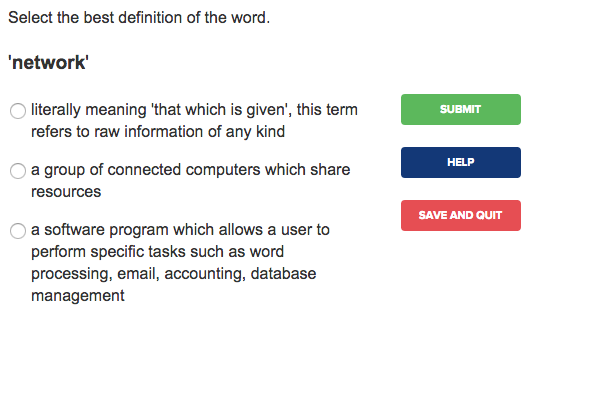
Multiple Choice Activity
Select the best match between unit terms and their definitions.
Free Demo
Listening Comprehension Activity
Listen to short audio clips in English and then spell them correctly.
Free Demo
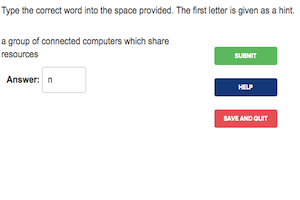
Spelling and Recognition
Identify and spell a vocabulary term correctly given only the definition.
Free Demo
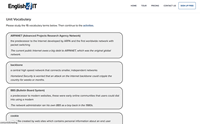
Vocabulary Builder Activity
Students will learn the following key terms and phrases:
Improve your reading comprehension and vocabulary in context with our interactive reader.
In this unit you will learn about different types of computers and what makes them unique.
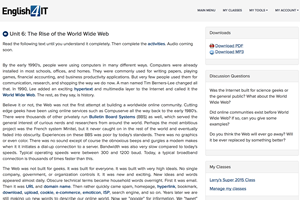
Computers were not always things you could carry around with you, or even have in your bedroom. Sixty years ago, computers (such as ENIAC) were as big as entire apartments. They were difficult to use and not very powerful by today's standards. They also cost a lot of money to build and operate. So computers…
Premium Practice
Premium
Speaking Practice Activity
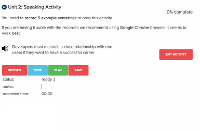
Master your pronunciation by recording yourself and receiving feedback from native-speaking teachers.
US
UK
A typical supercomputer may have up to 100 processors and speeds are measured in tens of gigaflops.
US
UK
The secretary could not get a hard copy because the print server was broken.
US
UK
Bill Gates predicted the rise of the tablet PC in 2001, but not much happened until Apple released the first iPad in 2010.
... and more sentences to practice.
Premium
Writing Practice Activity
Improve your writing skills with guided essay questions and professional correction.
- What is meant by the term 'convergence'?
- Why did companies in the 1980's shift away from mainframes and move towards personal computers?